About
What we choose to remember
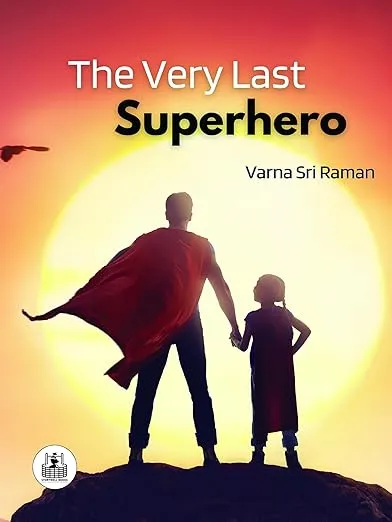
The Very Last Superhero is a fully illustrated speculative fiction novel set in a climate-collapsed India, blending AI, memory and resistance through the eyes of a fourteen-year-old girl.
It begins after the era of superheroes rather than during it. In the 2040s and 50s, state- and corporate-backed heroes publicly tackled crime, pollution and dissent, and surveillance, which was welcomed at first, became ordinary. What followed was a sequence of events: the Bangladesh flood, the Disclosures, an AI-authored National Curriculum, and the failure of four embankments on the Yamuna.
In the ruins, heroism is memory, care, and the courage to hold a community together when everything else has fallen apart. The Resistance is librarians, scientists, elders and teenagers running a filing system nobody in power can find.
Themes
- Climate collapse and adaptation
- Memory, oral history and the archive
- AI, surveillance and technology ethics
- Youth agency and intergenerational knowledge
- Care economies and post-heroic politics
Where it comes from
Two of the book's places are drawn from real ones the author has worked in, and she names them in the afterword. Nandini's transformed tea stall echoes the idea of asarai, the resting places that once sheltered travellers on the trade routes, and more particularly the CSDS Sarai initiative of the early 2000s, which made spaces where technology, community and critical thought could sit together outside institutional control. Mr Mehta's library in Ramnagar builds on her involvement with the Bansa Community Library in rural Uttar Pradesh, and what happens when books and ideas reach a place the formal system has given up on.
These aren't just theoretical models or distant references — they are living initiatives that have shown how the architecture of resistance can be built, maintained, and passed forward through generations.
From the printed afterword, adapted at On the Making
On the making of it
The afterword is printed in the book, and an adapted version is atOn the Making. Its argument is that the superheroes were never the point: they were state mechanisms, designed for obedience and incapable of love, and the era that produced them grew out of post-truth politics, rewritten curricula and mythologised history rather than preceding it.
Sumati is a child with no powers, trying to understand what she has inherited. Her search for her father turns into a search for something older: shared memory, collective doubt, and the remnants of reason. She learns from relics, ruins, animals and ghosts. She knows from listening.
The Firebird — etched on walls, drawn in soot — was their symbol. Not official. Not claimed. But everywhere. A reminder that collapse doesn't mean the end. It means the truth has outlived its suppressors.
From the printed afterword, adapted at On the Making
The illustrations were made with generative tools, manual curation and narrative revision. Some are memories the characters never see, some are false, and some are true.
They are not illustrations. They are records.
From the printed afterword, adapted at On the Making
Why waste-to-energy
The novel is dedicated in part to Dev, "for being the courageous father he is, battling Delhi's waste-to-energy plants all along." That fight is real, and the book's argument, that the unglamorous, community-based work is the work that counts, comes directly out of it.
You can read about the ongoing campaign atThe battle against Delhi's waste-to-energy plants.
The book
- Author & illustrator
- Varna Sri Raman
- Publisher
- StoryWell Books Foundation, New Delhi
- Edition
- First Edition 2026
- ISBN
- 978-93-95373-08-1
- Chapters
- 17, plus a prologue and an afterword
On the publisher's site, the code WELCOME10 takes 10% off your first order.
Credits
Written and illustrated by Varna Sri Raman. Published by StoryWell Books Foundation. Site and interior artwork generated with AI image tools from written prompts, then selected and sequenced by hand.
Story, lore and artwork are licensedCC BY-NC-ND 4.0; the site's source code is MIT. Enquiries:info@storywell.in.